
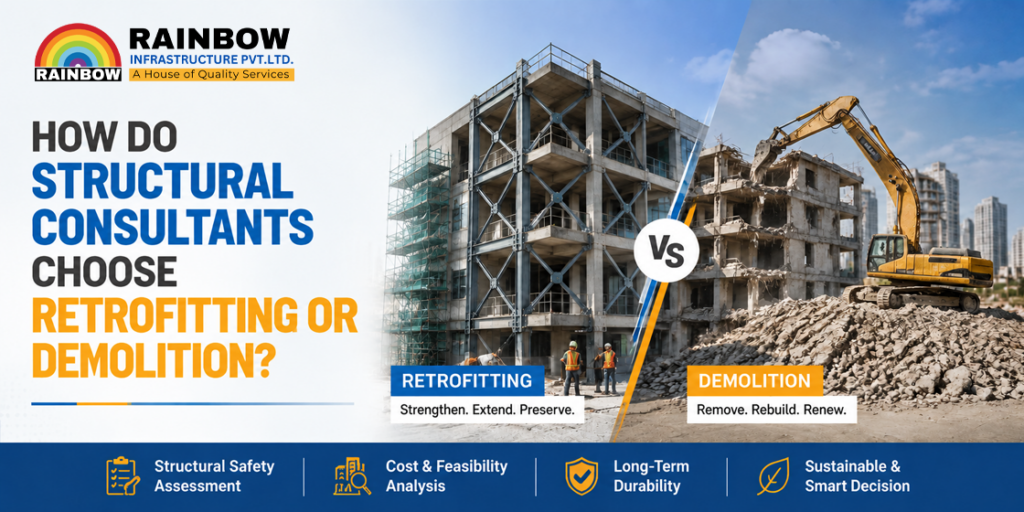
Structural consultants decide whether to retrofit or demolish depending on the extent of structural damage, whether its foundation can still bear additional weight and how the repair costs compare with rebuilding from scratch. Structural engineering consultants in Kolkata weigh all three factors together before recommending a direction.
Table of Contents
- What Is the First Step a Structural Consultant Takes Before Recommending Retrofitting or Demolition?
- How Do Consultants Determine if a Building’s Foundation Can Support Retrofitting Work?
- What Role Do Building Age and Construction Materials Play in This Decision?
- How Much Does Cost Influence the Choice Between Retrofitting and Demolition?
- When Do Structural Consultants Recommend Demolition Over Retrofitting?
What Is the First Step a Structural Consultant Takes Before Recommending Retrofitting or Demolition?
The first step is a complete site inspection where consultants check the building from the foundation up for cracks, water damage and any signs the core structure has weakened over time. They also review its history, age, past repairs, and how it has been used, before forming an early opinion on what direction makes sense.
This groundwork matters because a wrong first impression can send an entire project down the wrong path. The best architectural design and engineering services in Kolkata treat this inspection stage as non-negotiable, since every later decision, from cost estimates to material choices, depends on getting this part right.
How Do Consultants Determine if a Building’s Foundation Can Support Retrofitting Work?
Consultants test the soil, check how much load the foundation has carried over the years, and read the cracks. A building can look completely fine above ground while its foundation has almost nothing left to give.
- Soil Testing: Soft or shifting ground can rule out retrofitting even when the walls above look solid.
- Load History: If a foundation is already close to its limit, there is little possibility of reinforcing it.
- Crack Patterns: Vertical cracks usually mean settling. Diagonal ones tend to point to something worse. Getting this reading wrong changes the entire plan.
Residential and commercial building design services in Kolkata run into the same foundation question eventually, because age doesn’t care what a building was built for.
Read More: Importance of Architectural Planning in Commercial Construction Projects
What Role Do Building Age and Construction Materials Play in This Decision?
Materials matter more than age. A hundred-year-old brick structure and a fifty-year-old concrete one don’t fail the same way, so they don’t get tested the same way either.
Older buildings, especially ones built with techniques nobody uses anymore, tend to need deeper testing because their behaviour under stress is harder to predict. Concrete, steel, and brick all age differently, and a consultant needs to know exactly which one they’re working with before recommending a fix.
Industrial architectural planning and engineering solutions in Kolkata run into this constantly too, since factories and warehouses push materials harder than most buildings ever will, so weak spots tend to show up faster.
How Much Does Cost Influence the Choice Between Retrofitting and Demolition?
Structural consultants compare what it costs to reinforce the existing structure against what it costs to clear it and start fresh.
- Repair Versus Rebuild: If retrofitting stays well below the cost of demolition and reconstruction, it usually wins on economics alone.
- Hidden Costs: Asbestos removal or a foundation problem nobody saw coming can push retrofit prices past what a new build costs.
- Long-Term Value: A low-cost fix now doesn’t always stay low-cost. Consultants look past the first bill, because what you save today can quietly cost more in upkeep five years from now.
A turnkey architectural and construction design company in Kolkata usually has this cost conversation early, before anyone gets attached to a particular outcome.
When Do Structural Consultants Recommend Demolition Over Retrofitting?
Structural consultants recommend demolition when structural damage runs too deep to fix safely, or when a building’s layout can’t be adapted no matter how much reinforcement gets added. Deep corrosion, foundation failure, and fatigue that’s gone unchecked for years all push a structure past the point where reinforcing it is still a repair rather than a gamble.
Hire Our Structural Consultants To Make the Right Call
Every old building eventually reaches this fork in the road, and the right answer depends on details most people never think to check. That’s exactly why it’s worth contacting Rainbow Infrastructure. Our structural engineering consultants make this call every day, whether a building needs strengthening or a fresh start. If your building is showing early signs of wear, get it inspected before the decision gets made for you.
In our next blog, we’ll look at what happens after the decision is made, when a project moves into design, and how that early planning shapes everything built afterwards.
Frequently Asked Questions
Will retrofitting mean you have to move out during the work?
Depending on the extent of reinforcement needed, you can often continue using parts of the building while work happens in sections.
How soon can you find out if your building qualifies for retrofitting?
An initial structural inspection usually gives you a clear direction within the first few site visits, before any detailed testing begins.
What happens after the retrofitting or demolition decision is made?
You move into detailed planning, where engineers finalise drawings, load calculations, and timelines specific to the path chosen for your building.